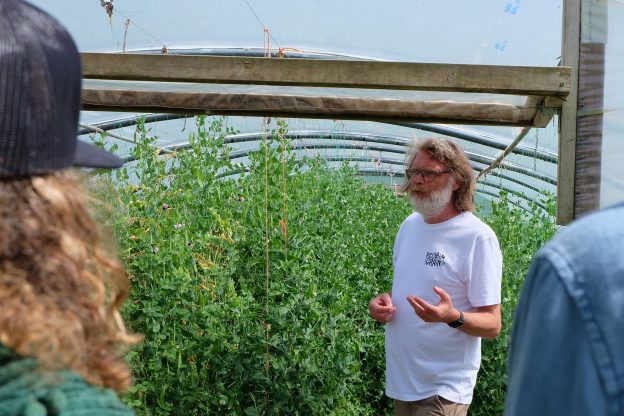
Rudolf Steiner, Geoff Mollison and others see a farm as a whole – a self-contained organism where one-part complements and or supports another and each has its own functions and needs. A whole ecosystem that is as self-nourishing as possible – buying in as little as possible and feeding out excess as food for the…Continue reading Family of farms day 2022: Bringing Consciousness into detail
Could Tígín Tiny Homes be the answer to the problem of farm workers accommodation?
We’re interested in how worker wellbeing can be better harnessed for new entrant farmers and growers on agroecological farms through the lens of worker accommodation. Our question is how can we better attend to farm workers, students and trainee’s welfare needs on agroecological farms? More entrant farmers are needed across the UK agroecological sector and…Continue reading Could Tígín Tiny Homes be the answer to the problem of farm workers accommodation?
Building Better Connective Systems through Local Food and Farming
“The UK has one of the highest levels of concentrated landownership in the world, with less than 1% of the population owning over half of all agricultural land. Over the past 20 years, 50,000 small-scale farms in the UK have either closed or ‘consolidated’, in part due to little government support for anyone farming on…Continue reading Building Better Connective Systems through Local Food and Farming
Letters of urgency in response to Monbiot’s one-sided arguments on the role of livestock and climate changE
Some weeks ago environmental activist and Guardian columnist George Monbiot spoke out once again about the damaging role of livestock on the planet’s resources, destruction of landscapes, habitats and ecosystems. Time again we hear Monbiot frame livestock in this way, only this time it’s a direct attack on organic, pasture-fed ruminants and concurrently the Agroecology…Continue reading Letters of urgency in response to Monbiot’s one-sided arguments on the role of livestock and climate changE